
How Each Type Gets Nutrients to the Root
Granular fertilizer sits on the soil surface or in a band until moisture dissolves it. Once dissolved, the nutrients enter the soil solution and move toward roots through mass flow and diffusion. That dissolution step takes minutes to hours in moist soil, but in dry conditions, granules can sit undissolved for days.
Liquid fertilizer is already in solution. When it hits the soil, nutrients are immediately available in the root zone. There’s no waiting for dissolution. That’s why liquid is often the go-to for starter fertilizer at planting, when you need nutrients available to seedlings right now.
Long-term university research from Michigan State and Penn State confirms that when you compare the same nutrient rate, same placement, and same chemical form, dry and liquid fertilizers produce identical crop yields. The plant root doesn’t care whether the nitrogen arrived as a granule or a spray. By the time it reaches the root, it’s all nitrate.
Where Granular Fertilizer Has the Edge
Cost is the biggest advantage. Granular fertilizer is cheaper per unit of nutrient, especially in bulk. A 40-pound bag of granular covers roughly the same area as $30 to $60 worth of liquid concentrate. For large-acreage operations where you’re spreading thousands of pounds of P and K in the fall, granular wins on economics alone.
Storage is simpler too. Granular keeps in a dry, cool building for months or years without degrading. No pumps, no tanks, no risk of the product separating or crystallizing. And you can custom-blend granular mixes by combining individual products like 46-0-0, 18-46-0, and 0-0-60 in whatever ratio your soil test calls for.
Slow-release properties work in granular’s favor for season-long crops. The gradual dissolution means nutrients feed the plant over weeks rather than all at once, reducing the frequency of application passes.
Where Liquid Fertilizer Has the Edge
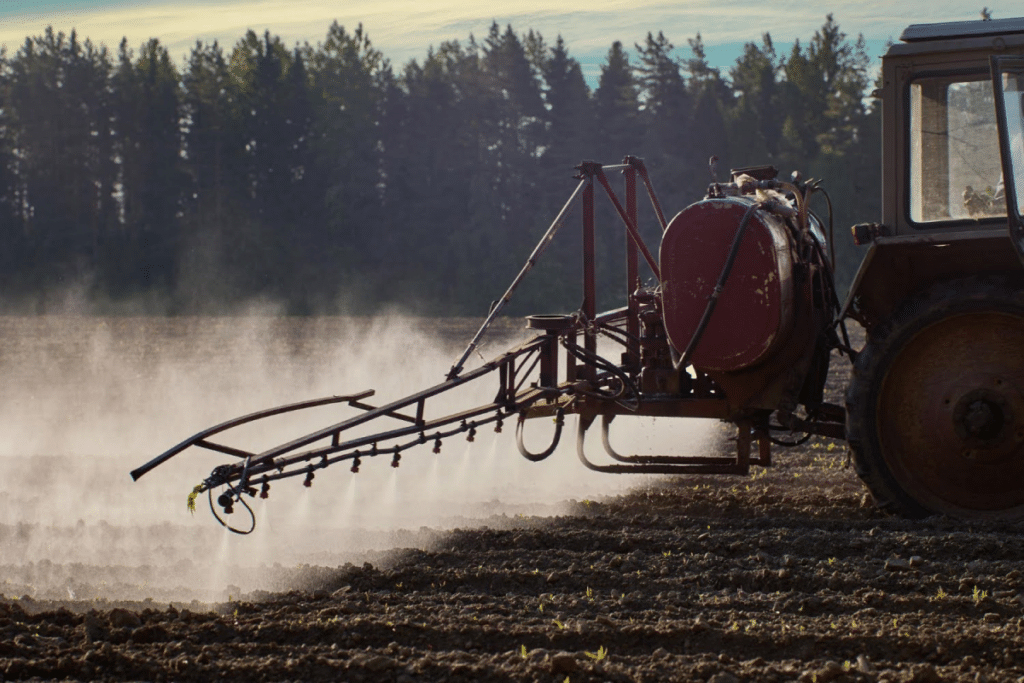
Precision is liquid’s strongest card. With fertigation (injecting through irrigation systems) or variable-rate spray rigs, you can deliver exact doses to specific zones in the field based on soil test maps or satellite imagery. Every drop contains a uniform nutrient concentration. Granules, by contrast, can segregate during handling, and each individual granule has a different nutrient profile in a blend.
Liquid is easier to band at planting. Saddle tanks on the tractor hold more volume than dry boxes on the planter, and you stop less often to refill. For in-furrow starter or 2×2 placement, liquid flows through tubes and nozzles cleanly. Granular banding requires different equipment and can bridge or plug in narrow openers.
Foliar feeding is a liquid-only option. Spraying diluted fertilizer directly onto leaves can correct mid-season deficiencies in hours rather than days. It’s not a substitute for soil-applied fertility, but it’s a valuable rescue tool when tissue tests show a shortfall during critical growth stages.
The Real Answer: Most Farms Use Both
The sharpest operators don’t pick sides. They use granular for base-layer P and K in the fall, when cost efficiency matters most and nutrients have all winter to incorporate. Then they switch to liquid for in-season nitrogen applications, starter at planting, and targeted foliar feeds timed to crop stage. DeWitt County Producers offers both dry and liquid fertilizer services with custom blending and application to match your program.
Your soil type matters too. Heavy clay soils hold granular nutrients well, but light sandy soils can lose them to leaching. Liquid applied through drip irrigation stays in the root zone more reliably on sandier ground.
Matching Fertilizer Type to Your Operation
Lean toward granular if: you’re covering large acreage, applying fall broadcast P and K, you need lower per-unit cost, or your fields have good soil moisture at application time.
Lean toward liquid if: you need precision placement, you’re running starter at planting, you have fertigation infrastructure, or you need to correct mid-season deficiencies fast.
Talk to your agronomist and start with a soil test. The fertilizer type only matters after you know what your fields actually need. Check out our full range of products and services or contact the DeWitt County Producers team at (361) 275-3441 to build a fertility program that matches your crops, your equipment, and your budget.